Top 10 Questions Homeowners Ask About Gate Locks — Answered

Buying a gate lock sounds simple — until you actually start shopping.
Suddenly you're comparing materials, lock types, weather ratings, and installation methods — and wondering whether your gate will even work with the lock you've chosen.
You're not alone. These are the questions homeowners search for every day, and they deserve honest, specific answers — not vague generalities. Whether you're securing a backyard, pool entrance, side yard, or garden gate, this guide answers the top 10 real questions homeowners ask about gate locks, with specific guidance on what to look for and where Yardlock fits in.
In this guide
- What type of gate lock is best for residential homes?
- Are combination gate locks actually secure?
- Will a gate lock work on an uneven or sagging gate?
- Are gate locks truly weatherproof?
- Can I install a gate lock myself?
- Are gate locks safe for homes with children or pets?
- Do gate locks require a lot of maintenance?
- Can I change the code on a combination gate lock?
- Will a gate lock fit any gate type?
- How long should a quality gate lock last?
Question 1
What type of gate lock is best for residential homes?
For most homeowners, a mechanical keyless combination gate lock is the best all-around option — and here's why.
Traditional keyed padlocks create problems you've probably already experienced: lost keys, the cost of duplicates, lockouts, and the inconvenience of handing keys to guests, neighbours, or service providers. Smart electronic locks solve some of those problems but introduce new ones — they need batteries, connectivity, and can fail in cold weather.
Mechanical combination locks occupy the sweet spot: no keys, no batteries, no Wi-Fi, no app required. They operate purely through physical dials, making them exceptionally reliable in all climates and conditions.
For a residential gate, the core criteria are:
- Keyless convenience — no lost or copied keys to worry about
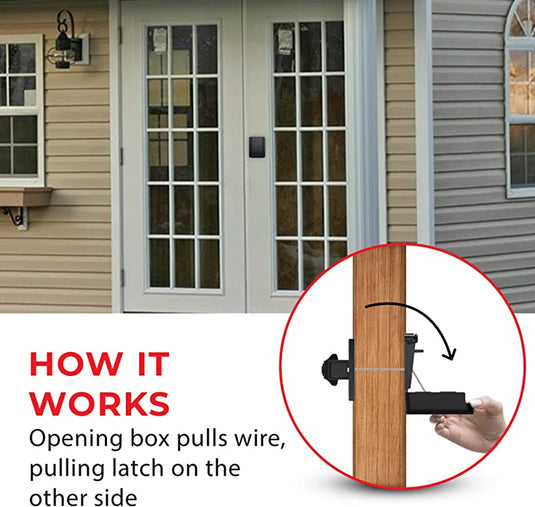
- Two Way Access — provides two way access in and out of your yard.
- Easy access control — change the code yourself in minutes without tools
- All-weather reliability — operates in rain, heat, UV exposure, and freezing temperatures
- One-handed operation — usable from either side of the gate
- Mechanical simplicity — nothing to charge, update, or reset after a power outage
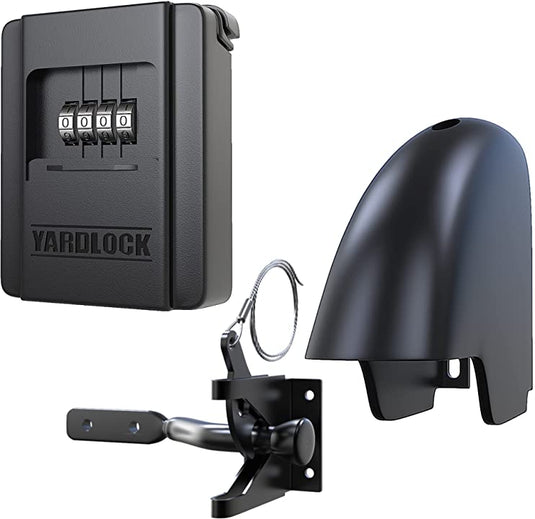
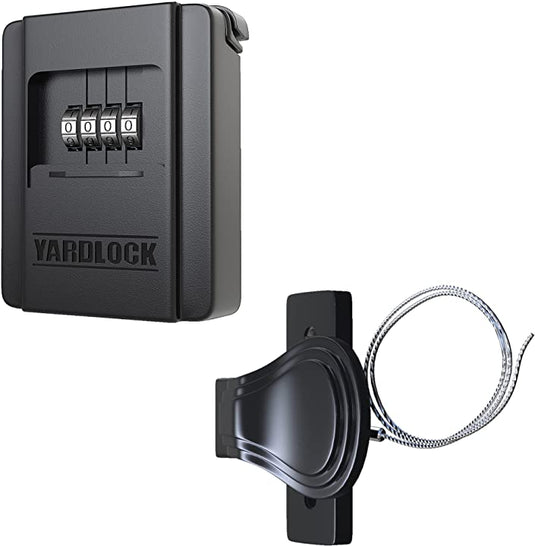
Yardlock's patented gate locks (US Patent #9528306) were specifically engineered for residential outdoor use, combining all five of these traits in a single weatherproof unit.
Yardlock recommendation
Gate Lock
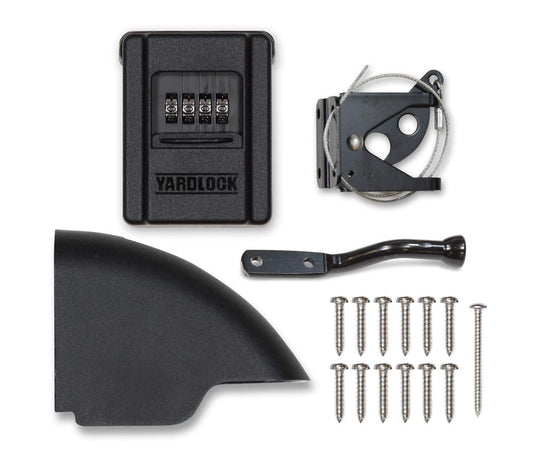
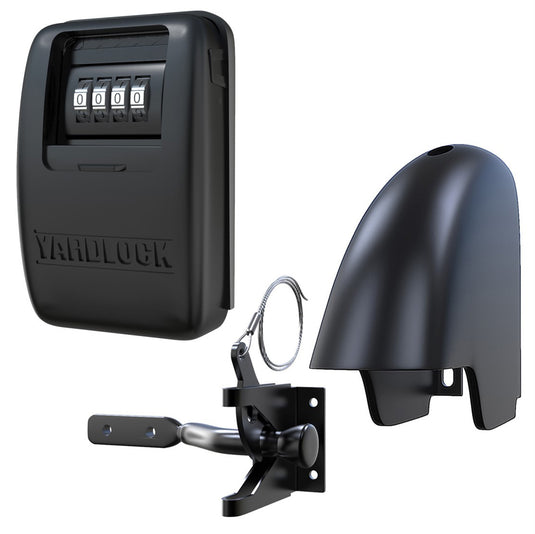
The original Yardlock Gate Lock fits wood and vinyl posts. Keyless, battery-free, and weather resistant. 10,000 possible combinations. Includes a built-in key storage box. Winner of the NHPA Retailer's Choice Award 2022.
View the Gate Lock →Question 2
Are combination gate locks actually secure?
Yes — when built to the right standard, combination locks are a genuinely secure choice for outdoor gates.
Here's what makes a combination gate lock secure:
- High combination count: A 4-dial combination lock with 10 digits per dial gives 10,000 possible combinations. A casual trespasser cannot guess this randomly.
- No keyhole to pick: Traditional keyed locks can be picked, bumped, or shimmed. Combination locks have no keyhole to exploit.
- No key to copy or lose: There is no physical key that can be duplicated at a hardware store or stolen from your pocket.
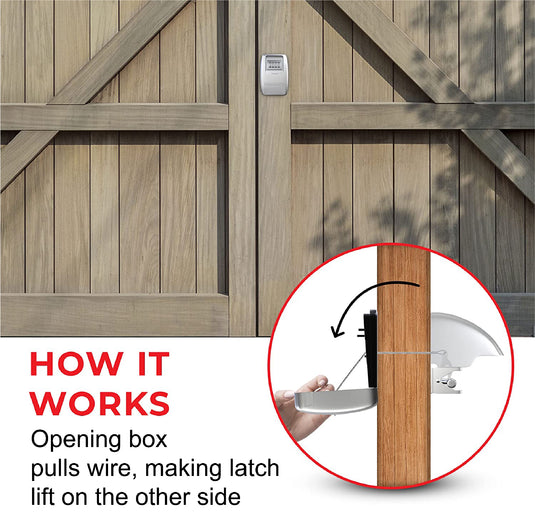
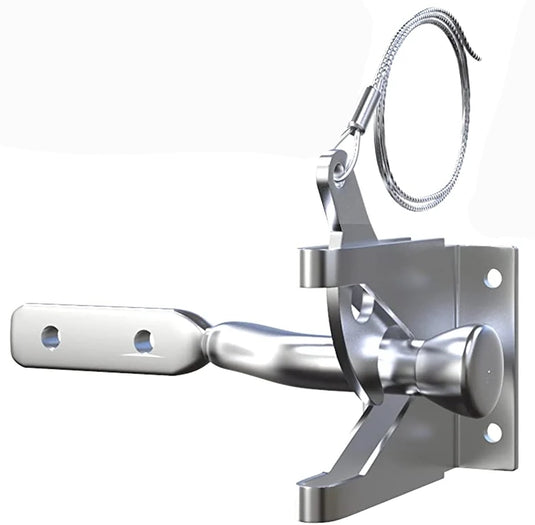
- Latch cover protection: Quality outdoor combination locks include a protective cover over the latch mechanism, preventing someone from reaching over the fence and flipping the latch by hand.
That last point is critical. A gate lock is only as secure as its latch design. The cover prevents direct manual access to the latch from outside the fence, which is the most common way residential gate latches are defeated.
For a residential gate, a quality mechanical combination lock provides security comparable to a keyed padlock — with none of the key-related vulnerabilities.
Important note
No gate lock replaces a fence. Gate locks are access control devices. If maximum security is your goal, pair your gate lock with a solid fence (no gaps at the latch area) and a secondary deadbolt if needed.
Question 3
Will a gate lock work on an uneven or sagging gate?
This is one of the most common concerns — and a very valid one.
Gates are not static structures. Wood expands and contracts with moisture and temperature changes. Posts lean over time. Hinges sag. The result is that even a perfectly installed lock can become stiff or misaligned months later.
There are two separate issues to understand:
- Gate alignment issues — These are the responsibility of the gate, not the lock. A severely out-of-square gate should be repaired before installing any lock. No lock compensates for a gate that sags 3 inches.
- Lock tolerance for minor misalignment — This is where lock design matters. Surface-mounted mechanical locks with spring-loaded latches perform significantly better on gates with minor sag or shift, because the latch can engage consistently at slightly different positions.
Yardlock's surface-mounted design is specifically engineered to handle minor post and gate variation. The spring-loaded latch engages reliably even when there is slight misalignment between post and gate. Detailed guidance is available in the Yardlock Troubleshooting Guide.
Installation tip
Install the Yardlock on a gate that is properly squared and hung. If the gate swings on its own or requires force to close, fix the alignment first. This extends lock life and ensures smooth operation year-round.
Question 4
Are gate locks weather resistant?
Most outdoor gate locks are marketed as weather-resistant — but there is a significant difference between weather-resistant and genuinely weatherproof. This is where many homeowners get burned.
A truly weatherproof outdoor gate lock must handle:
- Rain and sustained humidity — both from direct rainfall and ambient moisture
- Heat and UV exposure — prolonged sun degrades plastic components and fades coatings
- Freezing temperatures — the lock mechanism must operate even after overnight freezing
- Freeze-thaw cycles — repeated expansion and contraction that cracks lesser materials
The material composition is the key determinant. Locks made from zinc die cast bodies with rigid composite shells outperform standard padlocks in every outdoor condition. Zinc die cast resists rust, doesn't corrode, and maintains structural integrity across temperature extremes.
Cheaper outdoor locks often use low-grade zinc alloys or plastic housing that cracks within one or two winters. The combination mechanism inside also degrades if moisture enters through a poorly sealed housing.
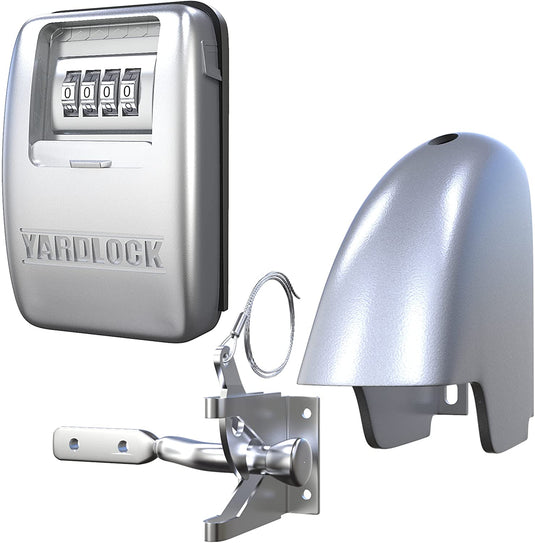
Yardlock's gate locks are built from zinc die cast bodies with rigid cast plastic shells specifically engineered to resist freezing, UV degradation, and rust. Customers in Alberta, Minnesota, and Ontario use these locks year-round at temperatures reaching -30°C / -22°F with no operational issues. For environments with salt air or coastal humidity, the Gate Lock XLS features stainless steel hardware for additional corrosion resistance.
Question 5
Can I install a gate lock myself?
In most cases, yes — and with Yardlock specifically, the answer is a confident yes.
Surface-mounted gate locks are designed for straightforward DIY installation. You do not need to cut into the gate, hire a locksmith, or own any specialist tools. Most installations are completed in 20–30 minutes.
What you typically need:
- A power drill or manual screwdriver
- The hardware included in the box — no separate trip to the hardware store required
- A level (optional but helpful for clean alignment)
Yardlock supports installations on wood and vinyl posts from 2.5"–4.5" wide. The lock can be mounted at any height on the post. Full step-by-step installation instructions are included in every box, with QR codes linking to dedicated video installation guides for standard posts and for narrow posts.
Installation tip
Install the lock with the gate open. With full access to both sides of the post, the process is much easier. Test the latch at least five times before calling it done — confirm smooth engagement in both locked and unlocked positions.
Question 6
Are gate locks safe for homes with children or pets?
Yes — and for family homes with children or pets, a quality gate lock is not just convenient, it is a genuine safety necessity.
Gate security for families serves three specific functions:
- Preventing children from accessing streets or pools — Pool drowning is the leading cause of accidental death for children aged 1–4 in the US. Many municipalities legally require pool gates with self-closing, self-latching, or combination locks.
- Controlling yard access — Combination locks let you grant access to trusted people (neighbours, dog walkers, family) with a shared code, without giving anyone a physical key that can be lost or copied.
Set your combination code to something adults can remember but children cannot easily guess. Avoid birth years or sequential numbers (1234). Change the code after any service provider visit.
For more detailed guidance, see our guide: How to Choose the Right Gate Lock for Pet and Child-Safe Yards.
Question 7
Do gate locks require a lot of maintenance?
A high-quality mechanical gate lock requires very little maintenance — and this is one of its primary advantages over keyed padlocks or smart locks.
Keyed locks have keyholes that collect dirt, grit, and moisture over time. Smart locks need battery replacements and firmware updates. Mechanical combination locks have neither of these vulnerabilities.
For a Yardlock gate lock, the maintenance routine is minimal:
- Wipe down occasionally — remove surface dirt, pollen, or debris from the housing and dial area with a damp cloth. Do not direct high-pressure water into the mechanism.
- Check gate alignment once a year — the most common cause of lock stiffness is not the lock itself but a gate that has shifted over time. A well-aligned gate means a smoothly operating lock.
- Inspect the mounting hardware — check that screws remain tight after the first winter. Temperature cycling can cause minor movement in the mounting.
No lubrication is needed under normal conditions. Yardlock's zinc die cast mechanism is designed to operate dry. If you experience dial stiffness after an extreme ice event, allow the lock to warm naturally — do not force the dials.
Yardlock lifetime warranty
All Yardlock gate locks are backed by a limited lifetime warranty against manufacturing defects. If you ever experience a hardware failure under normal operating conditions, contact Yardlock directly at sales@yardlock.com or call 1-844-463-9459.
Question 8
Can I change the code on a combination gate lock?
Yes — and this is one of the biggest practical advantages of a combination gate lock over any keyed alternative.
With a keyed lock, changing access means replacing the lock cylinder or having new keys cut. With a combination gate lock, you reset the code yourself in under 60 seconds, at no cost, without any tools.
Situations where changing the code is genuinely useful:
- After a contractor, cleaner, or service provider has finished work
- When a house guest leaves after a stay
- If you suspect the code has been shared without your knowledge
- At the start of each season as a general security habit
- When access arrangements with a neighbour or tenant change
Yardlock's combination reset process is described in the installation instructions and takes approximately 60 seconds. The process does not require disassembling the lock or removing it from the gate.
With 10,000 possible combinations from a 4-dial lock, you have significant choice in selecting a code that is memorable for your family but not guessable by others. Avoid sequential codes (1234), repeated digits (1111), or birth years.
Question 9
Will a gate lock fit any gate type?
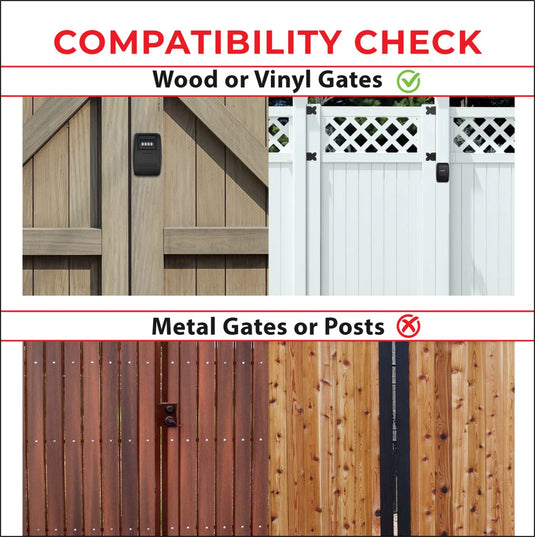
Not every gate lock fits every gate — and it's important to check compatibility before purchasing.
The key variables to assess for your specific gate:
- Post width: The most critical measurement. Measure the width of the post (not the gate panel) where the lock will mount.
- Gate material: Wood and vinyl gates are the most straightforward. Metal posts may require different hardware configurations.
- Gate swing direction: Most surface-mounted locks work on both inward and outward swinging gates, but confirm before purchasing.
- Available mounting height: Confirm there is a clear mounting area at your preferred height — typically adult waist height for ease of use, higher if child safety is the primary concern.
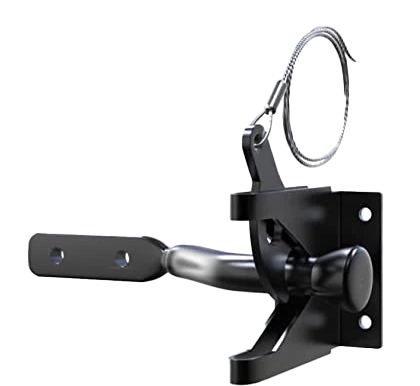
Yardlock gate locks are compatible with wood and vinyl posts from 2.5" to 4.5" wide and can be installed at any height. The Gate Lock and Gate Lock XLS are the standard models for most residential installations. The Gate Lock XLB is identical in fit to the XLS but in classic black.
If you're unsure whether your gate dimensions are compatible, the Yardlock team will advise for free before you buy — call 1-844-463-9459 or email sales@yardlock.com.
Question 10
How long should a quality gate lock last?
A quality outdoor gate lock should last for many years — and with the right product, potentially for the lifetime of the gate itself.
The factors that determine longevity:
- Material quality — zinc die cast bodies with composite shells significantly outlast plastic-bodied or low-grade zinc alloy locks
- Weather sealing — how well the housing prevents moisture ingress into the mechanism
- Gate alignment — a well-aligned gate causes far less mechanism wear than a sagging or binding gate
- Usage frequency — high-traffic gates (10+ opens daily) show wear faster, but a quality lock handles this without issue
Cheaper locks save money upfront, but frequent replacements add up quickly. A $15 padlock replaced every two seasons costs more over five years than a $65 quality gate lock that lasts a decade. The case for investing in quality outdoor hardware is straightforward.
Yardlock backs all gate locks with a limited lifetime warranty against manufacturing defects. Every lock is built to be the last gate lock you ever have to buy.
Award-winning quality
Yardlock won the NHPA Retailer's Choice Award in 2022 — recognition from industry professionals for product quality and customer satisfaction. US and Canada Patent registered (US #9528306). Limited lifetime warranty on all gate locks.
Yardlock model comparison: which lock is right for your gate?
| Feature |
Gate Lock |
Gate Lock XLS |
Gate Lock XLB |
Shed Lock |
|---|---|---|---|---|
| Post width fit | 2.5"–4.5" | 2.5"–4.5" | 2.5"–4.5" | Shed doors |
| Keyless / battery-free | ✓ Yes | ✓ Yes | ✓ Yes | ✓ Yes |
| Rust & freeze proof | ✓ Yes | ✓ Yes | ✓ Yes | ✓ Yes |
| XL dial (easier to read) | — | ✓ Yes | ✓ Yes | — |
| Stainless steel hardware | — | ✓ Yes | — | — |
| Colour | Black | Silver | Black | Black |
| Best for | Most wood & vinyl gates | Coastal / high humidity | Large gates, visual upgrade | Sheds & barns |
Ready to secure your gate?
Free shipping over $100 · 30-day money-back guarantee · Limited lifetime warranty on all locks
Shop all Yardlock gate locks →Final thoughts
Gate locks don't have to be confusing. Once you understand what actually matters — material quality, weather resistance, post compatibility, and latch design — the decision becomes straightforward.
Outdoor security works best when quality hardware, proper gate alignment, and thoughtful installation come together. The right gate lock should feel secure, be effortless to use, and be built to handle real-world conditions — not just fair-weather ones.
If you have a question that wasn't answered here, contact the Yardlock team directly. We're happy to advise on the right lock for your specific gate before you buy.